
How to correctly choose a tile
Ceramic tiles have become very popular in all countries, on all continents. This building material is practical, durable, allows you to create unique design solutions, has an attractive appearance, can be used for exterior or interior decoration.
So that the final result of the repair does not disappoint you, when choosing tiles, you need to use the advice of specialists. In any case, do not choose tiles only by color scheme and design, but consider the following nuances.
Calculating the required amount of tiles
To get the correct figures, you need to measure the area of the room planned for repair. In any hardware store, you can consult with a sales consultant or independently determine the required amount of finishing material, focusing on the results of calculating the area and the information on the packaging.
To avoid unpleasant surprises at the final stage of repair work, when several tiles may not be enough, you need to purchase building materials 10% more than the calculated amount. During the work, the tile may break, chip, and additional trimming may be required to obtain the desired pattern.
When choosing the size of the tile, be sure to consider the dimensions of the room. You should not use small-sized tiles for large rooms, halls, and living rooms. A large number of seams during installation will significantly overload the space and visually reduce the dimensions.
Tiles of any size are suitable for small rooms. However, when using large-format tiles, first make the correct layout to avoid a large number of scraps, not to spoil the desired pattern, and reduce material consumption. Also, for small rooms, you need to purchase tiles in light pastel colors, which will visually expand the space. If you want to refresh the interior, you can use original accents of bright colors.
Types of decorative ceramic tiles
This common material is made from clay with subsequent molding and firing. It is distinguished by its great diversity, so when choosing it is necessary to take into account all aspects related to a particular type of tile. So, the classification is carried out according to the following criteria:
- Pressing method. There are dry and plastic processing products, which has a decisive impact on the strength, strict adherence to the final dimensions of the product. If every millimeter is important to you when working, then you should choose rectified tiles. Unlike other types, the edges of which are trimmed during molding and pressing, in this type the trimming occurs after firing, which provides clearer contours and stable dimensions.
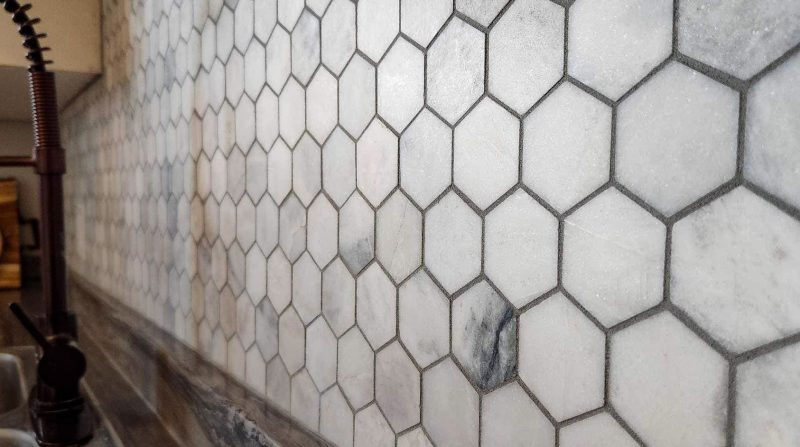
- Format and configuration. The modern market offers tiles of various shapes and sizes. There are square, rectangular, hexagonal and figured products with edge sizes from 10 mm to 1200 mm. It is also necessary to take into account the thickness of the tile, if space saving is very important to you.
- Material. According to this criterion, tiles, porcelain stoneware, clinker should be distinguished. Each of these types differs somewhat in the method of manufacture, properties and scope of application:
- tile is a material with a glazed surface, which is advisable to use for interior decoration when creating unique and practical interiors;
- porcelain stoneware is characterized by extreme strength, resistance to adverse external conditions, has low water absorption due to the complex manufacturing technology: molding under pressure and subsequent firing;
- clinker is manufactured by extrusion, which makes it possible to achieve a sufficiently dense and strong structure, high vapor and water permeability.
- Manufacturing process. There are several main production methods: bicottura, monocottura, monoporosa, gres, extrusion. The first method involves molding by pressing and firing in two stages, as a result we have an enameled tile. For glazed products, monocottura is used, that is, a process with a single firing. Monoporosa includes similar production stages, but using not only clay, but also carbonates. For the production of porcelain stoneware, a light-colored material is selected, which is subjected to mechanical processing after molding and firing.
- Surface type. Due to the properties of the surface of the tile, it has a different appearance and has different areas of application. A matte, slightly hard surface has a surface that is not processed after firing. Semi-polished products are obtained by grinding the upper matte layer. When the surface of the product is re-polished, complete closure of the pores is achieved and a polished tile is obtained. A structured relief product is obtained if three-dimensional patterns are used at the molding stage.
- Scope of application. Different properties, appearance, structure, shape and color of the tile determine the differences in the possibility of its installation in certain rooms. First of all, this applies to exterior and interior work, floors and walls, rooms with high humidity, etc. For example:
- If any tile can be used for walls, then for the floor – only a product with a matte or structured surface that provides minimal slippage.
- For small rooms, you should choose glossy tiles, thanks to which the room will look brighter and more spacious.
- When facing rooms with high humidity, it is advisable to use finishing materials with appropriate properties and strength.
- For curved, convex surfaces, columns or arches, it is better to use small-sized tiles.
Note. Another tip. To get a flawless tile installation, you need a perfect wall or floor surface. Only an experienced master can assess the condition of the area. If there are any irregularities, they will definitely need to be corrected.
After reading this minimal information, you can already independently choose tiles for the renovation of your home or office.